Battle class rules
This page explains how to configure federation class rules so that the Round Guide automatically generates the correct round skeleton — placing round, battle layers, B‑final — for each competitor count in a 1v1 battle discipline.
New to class rules? Read How class rules work first — this page builds on its ladder, stage and exception thinking, and its reference lists every condition, action and setting used below.
Competition operators: see Battle bracket setup for how to seed and run battles once the skeleton exists.
Battles danced in several rounds (two rounds plus a tie-break, or a bronze and gold battle under the final): see Battle sub-rounds.
What a battle class has to solve
A battle class turns a field of any size into a 1v1 knockout that ends in a final. Every rule on this page answers one of three questions:
- Who meets whom? A knockout is only fair if the strongest dancers meet late. So a battle class starts with a placing round that ranks everyone, and the bracket is seeded from that ranking — first against last, second against second-to-last (see Seeding).
- What if the field doesn’t fit a bracket? Brackets are built from pairs: 2, 4, 8, 16. A field of 5, 7 or 12 doesn’t fit, so something has to give. The placing round cuts the field down to the bracket, the top seed gets a bye, or the battles are danced in trios (crosses) instead of pairs.
- How deep may the bracket go? Whether a large field gets a round of 16 or is cut to the best 8 is a federation decision, not a technical one.
On top of that come the optional extras: a B‑final for third place, round names in the federation’s language, and judging and music per round.
Two approaches
| Approach | When to use |
|---|---|
| Brackets mode (recommended for new classes) | One trigger rule + a few optional modify rules handles every count automatically. Add this to a new class or replace a dense per-count ruleset. |
| Manual per-count rules (legacy / custom) | Fine-grained control, or when an existing ruleset is working and does not need migration. Fully supported; the two approaches cannot be mixed on the same class. |
The difference is how much the generator knows. In brackets mode it knows what a bracket is: it answers questions 1 and 2 above for every count by itself, and your rules only state the federation’s decisions — how deep, whether there is a B‑final, crosses or pairs, names, judging and music. In per-count mode it only knows a ladder of sizes, so every count has to be spelled out by hand: which round is the placing round, which rounds are battles, where the B‑final goes. That is why a per-count rule set runs to 13–17 rules and brackets mode to four or five.
Brackets mode
Brackets mode replaces the per-count round_sizes + round_type: battle approach with a single trigger rule. The generator builds the complete bracket skeleton — placing, quarter, semi, final, and optionally R16 — for any competitor count automatically.
Trigger rule
This is the rule that says “this class is a bracket” and “this is how deep it may go”. Create one base rule — no conditions and no action — whose changes are:
[
  { "key": "round_type", "value": "brackets" },
  { "key": "round_sizes", "value": [2, 4, 8, 200] }
]
The round_sizes value doubles as the bracket depth setting. The generator reads the largest finite value (anything below 200) as the maximum bracket entry size:
round_sizes | Max bracket entry | Effect |
|---|---|---|
[2, 4, 8, 200] | 8 | Quarter is the deepest battle level; counts ≥ 16 do not get an R16 round |
[2, 4, 8, 16, 200] | 16 | R16 (Åttondelsfinal) is added when count ≥ 16 |
What gets generated per count
Read this table as the generator’s answer to question 2 — what if the field doesn’t fit a bracket? It selects the bracket structure based on competitor count and max bracket entry:
| Count | Structure | Battle children |
|---|---|---|
| 2 | Final | 1 |
| 3 | Semi (1 trio, top 2 advance) → Final | 1 + 1 |
| 4–5 | Placing → Semi (2 pairs) → Final | 2 + 1 |
| 6 | Placing → Semi (3 pairs, or 2 trios via modify rule) → Final | 3 or 2 + 1 |
| 7 | Placing → Quarter (4 pairs, one bye) → Semi → Final | 4 + 2 + 1 |
| 8–max | Placing (all through) → Quarter → Semi → Final | 4 + 2 + 1 |
| > max, max=8 | Placing (top 8) → Quarter → Semi → Final | 4 + 2 + 1 |
| ≥ 16, max=16 | Placing → R16 (8 pairs) → Quarter → Semi → Final | 8 + 4 + 2 + 1 |
The pattern behind the rows:
- 2 — already a final; nothing to rank or cut.
- 3 — three can’t be paired, so the semifinal is one trio and the top two meet in the final.
- 4–5 — the placing round ranks everyone and the top four go into the semifinal pairs; with five, the fifth is cut there.
- 7 — one short of a full quarterfinal. Instead of cutting someone, the top seed gets a bye — the reward for placing first.
- More than the max — the placing round cuts the field to the bracket size (the top 8 when max is 8).
By default the Placing round uses select judging and the Final uses placement judging, both taken from the federation’s judging configuration. A per-round modify rule overrides the default — the examples below set judging: 10-0 on the placing round this way.
B‑final
Whether third place is decided by battle is a rulebook choice, so the B‑final is a decision, not a default: it is not auto-generated. Add an explicit add rule on the semifinal position:
| Condition | Action | Changes |
|---|---|---|
round == 2, from end | add | round_label: B-final, round_num_through: 0, round_position: 3, judging: match |
This keeps B‑final optional and lets you control which classes have one.
Crosses / trio mode for count 6
Six doesn’t split evenly into a bracket of pairs. Two trios do: each heat’s winner advances, which gives exactly the two finalists. Whether six dance pairs or trios is a rulebook choice, so it is a count rule — the one place a count condition is the right tool.
By default, count 6 produces a semi with 3 pairs of 2. To use trios (crosses) instead — two heats of 3, winner of each advancing — add a modify rule:
| Condition | Action | Changes |
|---|---|---|
count == 6, round == 2, from end | modify | judging: select, max_floor: 3 |
With max_floor: 3, the semi generates 2 trio children (3 competitors each, 1 advancing) instead of 3 pair children.
Customising round labels
Labels are what dancers, judges and screens see, so name the rounds in the federation’s own language. Set a round_label array on the trigger rule to name the bracket levels. The array maps from Final (index 0) outward:
{ "key": "round_label", "value": ["Final", "Semifinal", "Kvartsfinal", "Åttondelsfinal", "Uttagning"] }
Override a specific round’s label (e.g. the placing round) with a per-round modify rule:
| Condition | Action | Changes |
|---|---|---|
round == 1, from start | modify | round_label: ["Uttagning"] |
Placing round judging and music
The placing round’s job is to rank, so it is usually judged differently from the battles after it. Configure it with a condition that excludes very small brackets — at 2 and 3 competitors there is no placing round, and round 1 from start is the final or the trio semifinal:
| Condition | Action | Changes |
|---|---|---|
round == 1, from start, count >= 4 | modify | judging: 10-0, round_label: ["Uttagning"], max_floor: 4, dances |
round == 1, from end | modify | music_length: 240, extra_time: 40 |
Bracket settings
Some rulebook choices are switches rather than round changes. Set them in a modify rule (they are in the Bracket setting group of the rule editor); a count condition on the rule decides which class sizes they apply to.
- On the discipline’s Class Rules tab, click Add class rule (or Edit class rule on an existing one).
- Choose the battle Category the rule is for.
- Click Add round setting, pick a setting that starts with Bracket:, and set its value.
- Click Save changes.
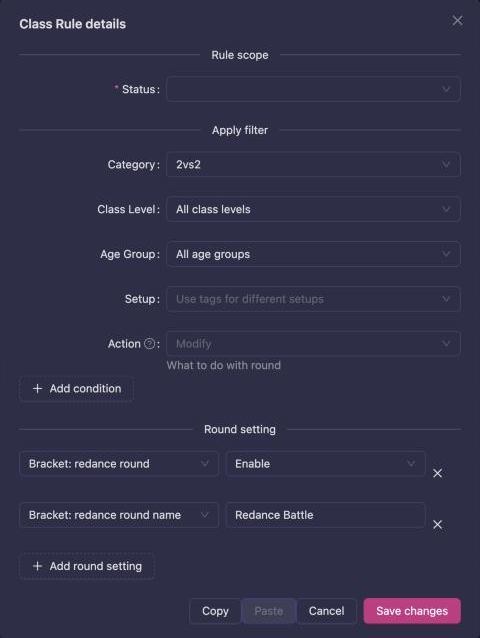
| Setting | What it does |
|---|---|
| Bracket: redance round | When the class is a few competitors over the bracket it fills (11 is 8 + 3), the extra competitors don’t drop out in the placing round. The last 2 × 3 places dance a redance round right after it, in battles of two, and its 3 winners take the last bracket places. The redance round is a normal round of its own, so the bracket after it is unchanged. Not used at or above the largest bracket, or when the class fills a bracket exactly. |
| Bracket: redance round name | The redance round’s name (default “Redance Battle”). |
| Bracket: redance round judging type | Its judging type. Without one, it is judged like the other battles (match judging). |
| Bracket: redance round comment / dances | Its comment, and the dances its battles are made from. A battle template dance (Battle [X]/[N]) makes one battle per pair. |
| Bracket: placing round name | The placing round’s name. |
| Bracket: top 4 from the placing round at 6 and 7 | At 6 and 7 competitors the placing round sends the top 4 to a semifinal, instead of trios or a round of 7 with a bye. |
| Bracket: final of 3 at 3 competitors | At 3 competitors the placing round sends all three to a final of three, instead of a trio and a final of two. The three dance together in one heat. |
| Bracket: final with gold and bronze battle | The semifinal sends all four on and the final holds two battles: gold for places 1–2 and bronze for places 3–4. |
Judging in brackets mode. Battle rounds use match judging. A rule may pick another match judging type for a round, and that choice is kept; any other judging type is replaced by the federation’s first match judging.
Complete example — Solo Champion Vuxna (R16 enabled)
| # | Conditions | Action | Changes |
|---|---|---|---|
| 1 | (none) | (none) | round_type: brackets, round_sizes: [2,4,8,16,200], round_label: ["Final","Semifinal","Kvartsfinal","Åttondelsfinal","Uttagning"] |
| 2 | round == 1, from start, count >= 4 | modify | judging: 10-0, round_label: ["Uttagning"], max_floor: 4, dances |
| 3 | round == 2, from end | add | round_label: B-Final, round_num_through: 0, round_position: 3, judging: match |
| 4 | round == 1, from end | modify | music_length: 240, extra_time: 40 |
Result: counts 2–15 get the standard Quarter→Semi→Final bracket; counts ≥ 16 automatically add an R16 layer. All handled by 4 rules instead of 13–17.
How to read it:
- The bracket itself — a bracket, up to a round of 16, with the names in Swedish.
- The placing round — how it is judged and danced, but only when there is one (
count >= 4). - Third place — a B‑final beside the semifinal.
- The final — longer music and extra time.
Nothing here mentions a specific count except the placing-round guard: the generator handles every field size, and the rules only carry the federation’s choices.
Complete example — Solo Champion Barn / FDO (max 8, with crosses)
| # | Conditions | Action | Changes |
|---|---|---|---|
| 1 | (none) | (none) | round_type: brackets, round_sizes: [2,4,8,200], round_label: ["Final","Semifinal","Kvartsfinal","Uttagning"] |
| 2 | round == 1, from start, count >= 4 | modify | judging: 10-0, round_label: ["Uttagning"], max_floor: 6 |
| 3 | count == 6, round == 2, from end | modify | judging: select, max_floor: 3 |
| 4 | round == 2, from end | add | round_label: B-Final, round_num_through: 0, round_position: 3, judging: match |
| 5 | round == 1, from end | modify | music_length: 240, extra_time: 40 |
Result: count 6 gets 2 trios (crosses) for the semi; all other counts use standard pairs. No R16 regardless of count.
Compared with Vuxna, the children’s class makes three different choices: the bracket stops at 8 (round_sizes without 16), the placing round is danced in heats of up to 6 (max_floor: 6), and six competitors dance crosses (rule 3) — the one count rule, because it is the one count where the rulebook breaks the pattern.
Manual per-count rules (legacy)
The following sections document the original approach: an explicit round_sizes rule plus round_type: battle modify rules for each competitor count. Use this approach for existing class rule sets that are already working. Both approaches are fully supported; do not mix them on the same class.
Why this section is so long. Here the generator only knows the ladder, not what a bracket is. It produces plain rounds, and your rules turn them into a bracket: this round is the placing round, these rounds are battles, the B‑final goes here. Because the right shape differs per count, each count gets its own rules. Every count below reads the same way: the ladder, what it generates, and the rules that turn those rounds into battles.
How round sizes work
The round_sizes rule sets the bracket ladder for the size loop:
[2, 4, 8, 16, 200]
Given 10 competitors and this ladder, the generator finds the first size larger than 10 (16) and builds downward: Placing(16) → Quarter(8) → Semi(4) → Final(2). A ladder size is the round’s capacity, not its headcount — all 10 competitors dance the placing round. When no size is larger than the count, the generator uses the largest size.
In the per-count sections below, the number in brackets after a round is how many competitors dance it.
Round sizes can be overridden per count — set round_sizes on a rule with a count condition to use a different ladder for a specific bracket size.
From-end conditions
Rules that should fire at a specific bracket position use a from-end condition: round == N, from end. This is count-agnostic — the Final is always round 1 from end, the Semi is round 2 from end, regardless of total rounds.
Rules that should only fire when a quarter exists combine two conditions:
round == 3, from end    ← the quarter layer
round >= 2, from start  ← excludes the first round (placing)
Count 2 — direct final
round_sizes: [2]
Single Final. No placing round.
Count 3 — crosses semifinal
Three can’t be paired, so the first round is a trio that sends two to the final; the third is automatically placed 3rd, so there is no B‑final.
round_sizes: [2, 3]
Generates: Placing(3, 2 advancing) → Final(2).
| Condition | Action | Changes |
|---|---|---|
count == 3, round == 1, from start | modify | judging: select, round_label: Semifinal, max_floor: 3, round_num_through: 2 |
Count 4 — semis + B‑final + final
round_sizes: [2, 4, 200]
Generates: Placing(4, all advancing) → Semi(4, 2 advancing) → Final(2).
| Condition | Action | Changes |
|---|---|---|
count == 4, round == 1, from start | modify | judging: 10-0 or select, round_num_through: 4 |
count == 4, round == 2, from end | modify | round_type: battle, judging: match, round_label: Semifinal |
count == 4, round == 1, from end | modify | round_type: battle, judging: match, round_label: Final |
count == 4, round == 2, from end | add | round_label: B-final, round_num_through: 0, judging: match |
Count 5 — 5th eliminated, then 4‑bracket
One too many for a four-bracket, so the placing round cuts one.
round_sizes: [2, 4, 200]
Same structure as count 4, but the placing round advances only 4.
| Condition | Action | Changes |
|---|---|---|
count == 5, round == 1, from start | modify | round_num_through: 4 |
Then apply the same battle + B‑final rules as count 4 with count == 5 conditions.
Count 6 — crosses semis + B‑final + final
round_sizes: [2, 6, 200]
Generates: Placing(6, all advancing) → Semi(6, 2 advancing) → Final(2).
| Condition | Action | Changes |
|---|---|---|
count == 6, round == 2, from end | modify | judging: select, round_label: Semifinal, max_floor: 3, round_num_through: 2 |
count == 6, round == 2, from end | add | round_label: B-final, round_num_through: 0, judging: match |
Count 7 — one bye + adjusted bracket
One short of eight. Rather than cut anyone, the top seed gets a bye through the quarterfinal.
round_sizes: [2, 4, 7, 9]
Generates: Placing(7, all advancing) → Quarter(7, one bye) → Semi(4) → Final(2). The ladder’s 9 is the placing round’s capacity — the first size larger than 7 — and is what gives the class a quarter layer; the quarter’s size 7 is where Seed 1 gets the bye.
| Condition | Action | Changes |
|---|---|---|
count == 7, round == 1, from start | modify | round_num_through: 100%, judging: 10-0 |
count == 7, round == 3, from start | modify | round_type: battle, judging: match, round_label: Quarterfinal |
count == 7, round == 4, from start | modify | round_type: battle, judging: match, round_label: Semifinal |
count == 7, round == 4, from start | add | round_label: B-final, round_num_through: 0, judging: match, round_position: 3 |
Count 8 — standard 8‑bracket
round_sizes: [2, 4, 8, 21]
Generates: Placing(8, all advancing) → Quarter(8) → Semi(4) → Final(2).
| Condition | Action | Changes |
|---|---|---|
count == 8, round == 2, from end | modify | round_type: battle, judging: match, round_label: Quarterfinal |
count >= 8, round == 2, from end | add | round_label: B-final, round_num_through: 0, judging: match, round_position: 3 |
Count 9–20 — standard 4-layer bracket
round_sizes: [2, 4, 8, 21]
| Condition | Action | Changes |
|---|---|---|
count >= 9, count <= 20, round == 1, from start | modify | judging: 10-0, round_label: Placing round |
count >= 9, count <= 20, round == 2, from start | modify | round_type: battle, judging: match, round_label: Quarterfinal |
count >= 9, count <= 20, round == 3, from start | modify | round_type: battle, judging: match, round_label: Semifinal |
count >= 9, count <= 20, round == 3, from start | add | round_label: B-final, round_num_through: 0, judging: match, round_position: 3 |
Count 21 or more — qualification + placing + bracket
A qualification round selects the field first, then a placing round ranks it for the bracket.
round_sizes: [2, 4, 8, 16, 200]
| Condition | Action | Changes |
|---|---|---|
count >= 21, round == 1, from start | modify | judging: select, round_label: Qualification round |
count >= 21, round == 2, from start | modify | judging: 10-0, round_label: Placing round |
count >= 21, round == 3, from start | modify | round_type: battle, judging: match, round_label: Quarterfinal |
count >= 21, round == 4, from start | modify | round_type: battle, judging: match, round_label: Semifinal |
count >= 21, round == 4, from start | add | round_label: B-final, round_num_through: 0, judging: match, round_position: 3 |
The B‑final add rule
Applies to both approaches. The B‑final gives the two semifinal losers a battle for third place instead of sharing it. The key fields:
| Field | Value | Effect |
|---|---|---|
round_label | B-final | Name shown in the round list |
round_num_through | 0 | Nobody advances from the B‑final |
round_position | 3 | Losers placed 3rd (runner-up position offset) |
judging | match | 1v1 battle judging |
When the add rule fires, the generator creates the B‑final alongside the semi. Setting round_others_id on the semi to point to the B‑final (done automatically when using the Round Guide import) means the Assign teams button routes semi losers to the B‑final without operator action.
Seeding — how it works automatically
When an organiser runs Assign to match on a battle round and picks a source round, the system applies the tournament bracket generator:
- From a non-battle source (placing or qualifying round): seeds by placement rank using the standard fold — Seed 1 vs last, Seed 2 vs second-to-last, etc. For 8 competitors this produces 1v8, 2v7, 3v6, 4v5.
- From a battle source (previous bracket layer): collapses winners from each previous match into new pairings, preserving the bracket structure.
- Byes (size 7): when the fold produces a match with no second competitor, that slot is empty. The single competitor advances automatically.
No configuration is needed for seeding — it is always determined by the source round’s placement results.
The fold is what makes the placing round matter: the better you place, the weaker your first opponent, and the top two seeds can only meet in the final.
Validating your setup
After creating or editing rules, open the Round Guide for a test competition class and try several competitor counts. Confirm:
- The correct number of rounds is generated for each count.
- Battle rounds show children (one per match).
- The B‑final appears alongside the semifinal, not after the final.
- For count 2: only a Final is generated (no placing round).
- For count 3: the semi uses select judging.
- For count 6 with crosses: the semi generates 2 trio children (3 competitors each).
- For count 7: the quarterfinal shows 4 battles, one of which will receive only Seed 1 when seeded.
- For brackets mode with max=16: counts 16+ produce an R16 layer; counts below 16 do not.